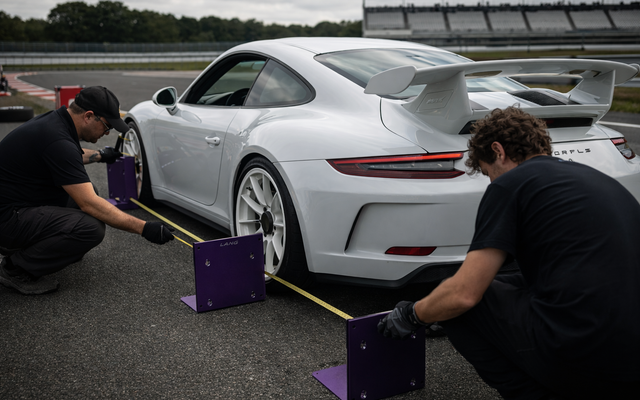
Inside the demanding world of today's professional drifting, success is no longer exclusively a product of sheer engine power or behind-the-wheel bravado. Instead, it has become a intricate science that demands a scrupulous blend of choosing a inherently capable car, arming it with the most precise competition components, and, most essentially, understanding its dynamic performance on the course through advanced vehicle dynamics analysis tools. This definitive guide functions as your roadmap from the initial idea of a competition vehicle all the way to the final engineering-refined refinements that transform a powerful machine into a predictable champion. We will examine in detail the precise engineering of vehicle alignment optimization, illustrating how a advanced suspension tuning tool like precise measurement hardware eliminates assumptions and delivers exceptional insight into your vehicle's real-world behavior.
The cornerstone of any great competitive sliding vehicle is, without question, the chassis itself. Several cars have earned iconic reputation within the worldwide sliding scene due to their natural handling characteristics, strong build quality, and the immense range of performance parts available. Choosing the correct car is the initial and most significant selection a driver will make. To illustrate, the the E36 generation BMW is commonly accepted as among the finest all-around drift cars of all time. Its near-perfect 50/50 weight distribution, alongside a driven rear axle setup and robust inline-six powerplants, forms a car that is simultaneously easy to handle for beginners and incredibly effective in the possession of a expert pilot. The evolution of this philosophy, the BMW E46, builds upon these qualities with a increasingly sophisticated frame, wider wheel track for greater stability, and yet a greater degree of turning capability as standard from the manufacturer. Another dominant platform in the professional scene is the Corvette C6.
This V8-powered track weapon brings a unique set of advantages to the sliding world, such as a lightweight aluminium chassis, a backwards-positioned gearbox and differential unit that aids in an ideal balance, and the tremendous torque of a big LS-series V8 engine. This blend makes it an utter force on track, able of entering and maintaining continuous drifts with apparently minimal use of acceleration. For those looking for exceptional bang-for-the-buck, the Nissan Z33 stands out as a top-tier candidate. It is delivered from the factory with a rigid platform, a competent OEM locking differential, and the smooth VQ series motor that provides sufficient performance for learning and advancing in the sport. Its follow-up, the 370Z model, brings additional advancements in structural rigidity, steering geometry, and peak engine performance, cementing its status as a favorite pick among competitive competitors. Additional legendary cars that warrant consideration are the lightweight unique Mazda FC RX-7, the ever-present Nissan S13 240SX, the American Ford SN95, the more recent BMW E90, and the compact yet surprisingly fun and forgiving MX-5 Miata. Each of these chassis offers a different palette of traits, complexities, and possibilities, but they all have in common the fundamental components required to become a capable drift car.
However, picking the correct platform is only the beginning. To release the full capability of any of these vehicles, major changes to the steering geometry and damping and springing systems are completely non-negotiable. This is where the domain of performance tuning parts comes into critical focus. The most most game-changing modification for a serious drift car is the integration of a maximum-angle steering angle kit. These sophisticated assemblies, like those engineered by specialist companies like SLR Speed, are engineered to dramatically enhance the car's available turning lock. A factory street car is severely limited in how far its front wheels can turn, a design compromise for on-road use. In drifting, conversely, aggressive steering input is continuously necessary to control and maintain a slide. An angle kit substitutes the OEM uprights, linkages, and potentially control arms with components that enable the front tires to reach steering lock over 70 or even 80 degrees, compared to a average OEM angle of around 40 to 50 degrees.
This vastly increased steering angle provides the driver with dramatically greater command during a slide, making it far simpler to initiate a drift, hold it through a long turn, and change smoothly from one direction to the other. The improvement in drivability is truly revolutionary. Combined with a properly selected steering kit is the every bit as critical upgrade to the car's spring and damper setup. Off-the-shelf or even premium road adjustable suspension are simply not intended for the unique and extreme requirements of competitive oversteer. A purpose-built set of adjustable dampers is paramount. These specific dampers feature specific valving and spring stiffness that are designed for the rapid mass transition that is inherent of aggressive driving. When a driver starts a drift, the car's weight is transferred forcefully to the front of the bend. Correct drift-spec coilovers handle this movement in a predictable manner, permitting the car to find its balance quickly and giving the operator precise feedback through the wheel and seat. They also enable exact setting of ground clearance, rebound and compression rate, and corner weighting, which are all fundamental parts of dialing in the car's dynamics to a specific track or driving technique. As a system, a precision-engineered drift angle kit and a correctly chosen system of competition suspension units are the absolute mechanical base upon which all later optimization is built.
Once the core parts is in place, the next vital stage in the development is the meticulous tuning of the car's alignment. This is the world of chassis dynamics adjustment, a methodology that can appear intimidating to the newcomer but is, in fact, the key to converting a set of fast components into a cohesive and controllable vehicle. The most discussed element of suspension geometry for oversteer is undoubtedly negative camber. Camber angle is the tilt of the tire in relation to the vertical plane when observed from the forward of the car. When the upper part of the tire is angled towards the chassis, this is referred to as negative camber. In sliding, inward-leaning wheels on the front axle wheels is universally employed and is considered critical. The reason is fundamentally tied to vehicle dynamics.
When a vehicle is cornering at extreme slip angles, the frame tilts towards the external of the bend. This chassis roll causes the outer front wheel to diminish its best contact patch with the asphalt. By applying negative camber, the tire is pre-leaned to compensate for this lean. As the chassis leans into the turn, the outside front tire gains a better contact patch with the road surface, maximizing its traction at the exact point when it is needed most for directional command. Typically, front camber settings for a dedicated drift car range from approximately -3 degrees to as much as -5 degrees or even greater, based on the specifics of the car configuration, compound selection, and pilot preference. The back tires also utilize inward lean, but the settings are usually more conservative and less aggressive than the front axle. Too much inward lean at the back can cause the vehicle to excessively prone to oversteer and hard to predict on acceleration input, as it reduces the usable contact patch of the driving wheels during straight-line power delivery. Thus, rear angles are frequently in the ballpark of -1 degree to -3 degrees, finding a delicate compromise between giving enough cornering bite to aid in initiating and maintaining the slide while simultaneously preserving effective traction for acceleration the turn. alignment is just one element of the broader suspension geometry puzzle, which also includes toe angle, caster angle, and suspension-induced steering modification.
Toe refers to the angle of the wheels as seen from the top. Toe-in means the leading edges of the tires are closer together than the trailing edges, while negative toe means the opposite. For sliding, a modest amount of front toe out is commonly run to improve the turn-in handling feel, making the car feel more nimble and ready to initiate a drift. Rear axle toe angle is typically set to zero or a incredibly minute amount of toe-in to encourage straight-line stability under throttle. Caster is the frontwards or aft angle of the suspension pivot when looked at from the lateral of the car. More caster enhances steering feel and stability confidence, and it furthermore boosts camber gain during turning, which is extremely advantageous. Setting these parameters is a intricate dance where a change to a single value can and will impact the remaining parameters. The old-school process for dialing in a car's alignment for competition has for a long time been a tedious endeavor of experimentation and feeling. A driver or engineering group would apply a change based on intuition, test the car on track, use the driver's individual feel and impressions, and then make an additional adjustment. This process would repeat time after time until the car felt "acceptable" or the available testing time was exhausted. This approach is not only incredibly wasteful in terms of hours and tires, fuel, and parts, but it is also deeply inaccurate.
Human sensation is a famously inconsistent data source, influenced by many variables such as fatigue, evolving track surfaces, temperature, and merely the mindset of the operator on that specific day. What feels "tail-happy" on one run might feel "pushing" on the following lap, resulting in conflicting information and ineffective adjustments. This age-old challenge in car suspension tuning is specifically where state-of-the-art telemetry systems has intervened to completely change the process.
The advent and adoption of sophisticated vehicle dynamics tools has brought about a new era for tuning and refining competitive drift cars. This new generation of tools, exemplified by cutting-edge solutions like modern telemetry hardware, function by actively capturing the real-time dynamic performance of the chassis as it is piloted on the course. As opposed to using personal impression, these systems collect measurable metrics on critical variables such as damper compression and extension, corner velocities, acceleration forces, lock position, and driver input position. This collected data stream is then processed by sophisticated applications that can graph and analyze the information in a actionable format. For the very first time, tuners and teams can visualize precisely what the car is doing at each moment of a drift. This function revolutionizes the complete chassis setup procedure. Consider the aforementioned task of dialing in the front axle camber for a particular vehicle. Rather than making a modification from -3 degrees to -3.5 degrees and then driving many runs to try and "feel" a improvement, a telemetry system can deliver immediate and irrefutable information. The application can show in a chart how the wheel's contact patch is performing during the critical moments of a drift: initiation, mid-corner, and changing direction. It can show if the current suspension engineering value is enabling the outside front tire to achieve maximum contact or if the rubber is overloaded on its external edge.
The software can subsequently suggest empirical advice for adjustment. Perhaps the data shows that the tire is still overworking its edge at -3.5 degrees of negative camber, indicating that an increase to inward lean, say -4 degrees, might be beneficial. Alternatively, the information might show that the tire is not achieving optimal operating temp or that the inner edge is degrading unevenly, which could point to that there is too much angle and a slight lessening back to -3.2 degrees would be better efficient. This level of granularity and actionable intelligence was completely unimaginable in the days of pure seat-of-the-pants setup.
The effect of using a comprehensive vehicle dynamics tool goes far beyond only setting alignment. It functions as an priceless damper adjustment manual that is specific to your particular car. When setting the damping settings on your coilovers, instead of depending on vague advice or copying another team's setup, you can use the telemetry to see how the car is behaving in reaction suspension tuning tool to your tweaks. The tool can display the suspension travel data over a run, revealing if the coilovers are managing the body movement properly or if they are permitting the car to become unsettled uncontrollably after a transition. It can aid in identifying issues like bottoming out or losing droop, enabling you to introduce informed adjustments to preload settings, damping rates, or stance. This approach applies just as well to the intricate art of car alignment tuning. Beyond camber angle, the software can provide data into how modifications to toe settings and caster angle are impacting the vehicle's handling during different maneuvers of a lap. For example, it can help you to determine the ideal amount of front axle negative toe for your particular steering rack configuration and piloting technique by measuring the speed of initial reaction and the consistency of the car at lock countersteer. This makes the system an incredibly useful vehicle dynamics manual that is actively informed by the real-world behavior of your own car on the tarmac. It moves the entire endeavor from a dark art into a scientific development process.
Furthermore, the utility of a tool like GripDial is not limited to coilover setup tips professional tuners with extensive budgets. For the amateur competitor, it acts as an powerful equalizer. It effectively gives the tuner with the analysis of a full-time race engineer without needing the typical expense. It drastically shortens the development time by providing clear directions to problems that would traditionally take countless track days of trial and error to solve. A driver can understand how their specific chassis reacts to various adjustments, developing a deeper knowledge of vehicle dynamics in the endeavor. It furthermore opens up advanced suspension engineering concepts, permitting every enthusiast with the desire to optimize their machine to accomplish it in a systematic and productive fashion. This is particularly significant in a activity like oversteer competition, where engineering expertise has in the past been a highly secretive advantage among top teams. Now, that capability can be in the garage of every serious enthusiast.
In summary, the process to engineering and optimizing the ultimate championship-contending drift machine is a comprehensive mission that smoothly combines proven engineering knowledge with 21st-century telemetry solutions. It commences with the informed pick of a legendary car, then built upon the application of non-negotiable competition parts like drift-spec angle modification systems and expertly selected competition adjustable dampers. The journey then progresses into the intricate realm of alignment optimization, where parameters like camber, toe setting, and caster angle are precisely set to suit the vehicle's modified geometry and the pilot's individual needs. The final step, and what really differentiates the today's methodology from the old ways, is the adoption of a advanced vehicle dynamics tool. This system removes the guesswork and trial and error of purely subjective tuning by giving empirical, actual telemetry on how the car is truly performing. It acts as an indispensable engineering partner, a actionable alignment optimization handbook, and a comprehensive performance analyzer. In unison, this holistic philosophy guarantees that each and every aspect of the competition vehicle—from the pick of the platform to the final tweak on the coilover—is optimized for ultimate success on the circuit. It embodies the complete maturation of the sport of drifting, connecting mechanical car control with surgical suspension engineering to create the perfect dominant cars possible.